
Explore Science Anywhere: How Virtual Science Labs Transform Learning
Explore how virtual science laboratories can support interactive experiments, scientific understanding and practical learning.
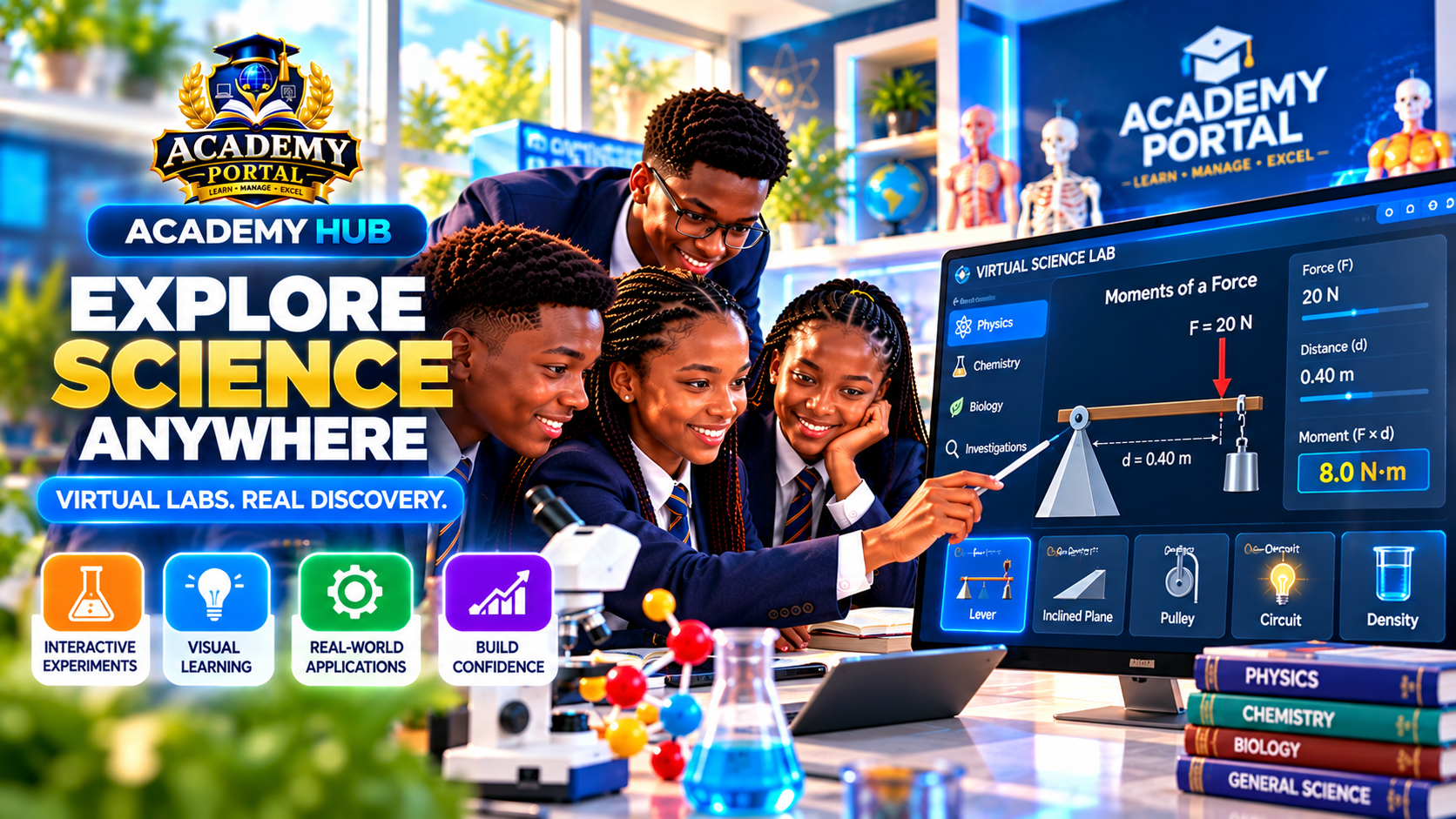
Science involves asking questions, changing variables, observing outcomes and using evidence to explain what happened. A virtual science lab can support that process through interactive simulated experiments.
What is a virtual laboratory?
A virtual laboratory is a digital environment that models aspects of an experiment or scientific system. A learner may change force, distance, mass, voltage or another variable and observe the simulated effect.
Virtual experiments do not make physical laboratories unnecessary. They can complement them.
Repeat without wasting materials
In a simulation, learners can often repeat an investigation quickly, change one variable at a time and compare outcomes. That can make patterns easier to notice.
Make abstract ideas visible
Interactive controls, measurements and visual feedback can connect a mathematical relationship with observable behaviour.
The important question is: What changed, what stayed constant, and why did the result change?
Prepare before practical work
A virtual lab can help students become familiar with a concept before physical practical work. Learners can practise identifying variables, predicting outcomes and recording results.
Learn from unexpected results
If an outcome differs from your prediction, investigate. Did more than one variable change? Did you misread a value? Does the model have assumptions you need to understand?
Know the limits of simulation
A simulation is a model. Physical experiments may involve measurement uncertainty, equipment limitations, friction, environmental conditions and human technique. Strong science education recognises both the power and limits of models.
A five-step virtual investigation
- Question — What relationship are you investigating?
- Predict — What do you think will happen?
- Change — Adjust one relevant variable while controlling others.
- Observe and record — Write down values and outcomes.
- Explain — Use the scientific principle to explain the pattern.
Repeat with additional values before drawing a conclusion.
From watching to investigating
Do not simply move controls randomly. Create a results table, look for relationships and challenge your conclusion with another test case.
Academy Hub takeaway: Virtual labs are most powerful when you predict, test, record, explain and connect the model back to real science.
Keep building on what you've learned.
Discover more practical technology, science, digital skills and learning resources across Academy Hub.