Turn Your Ideas Into Real Projects: A Simple Guide for Students
A practical student guide to moving from an idea to a planned, built and presented project with real-world impact.
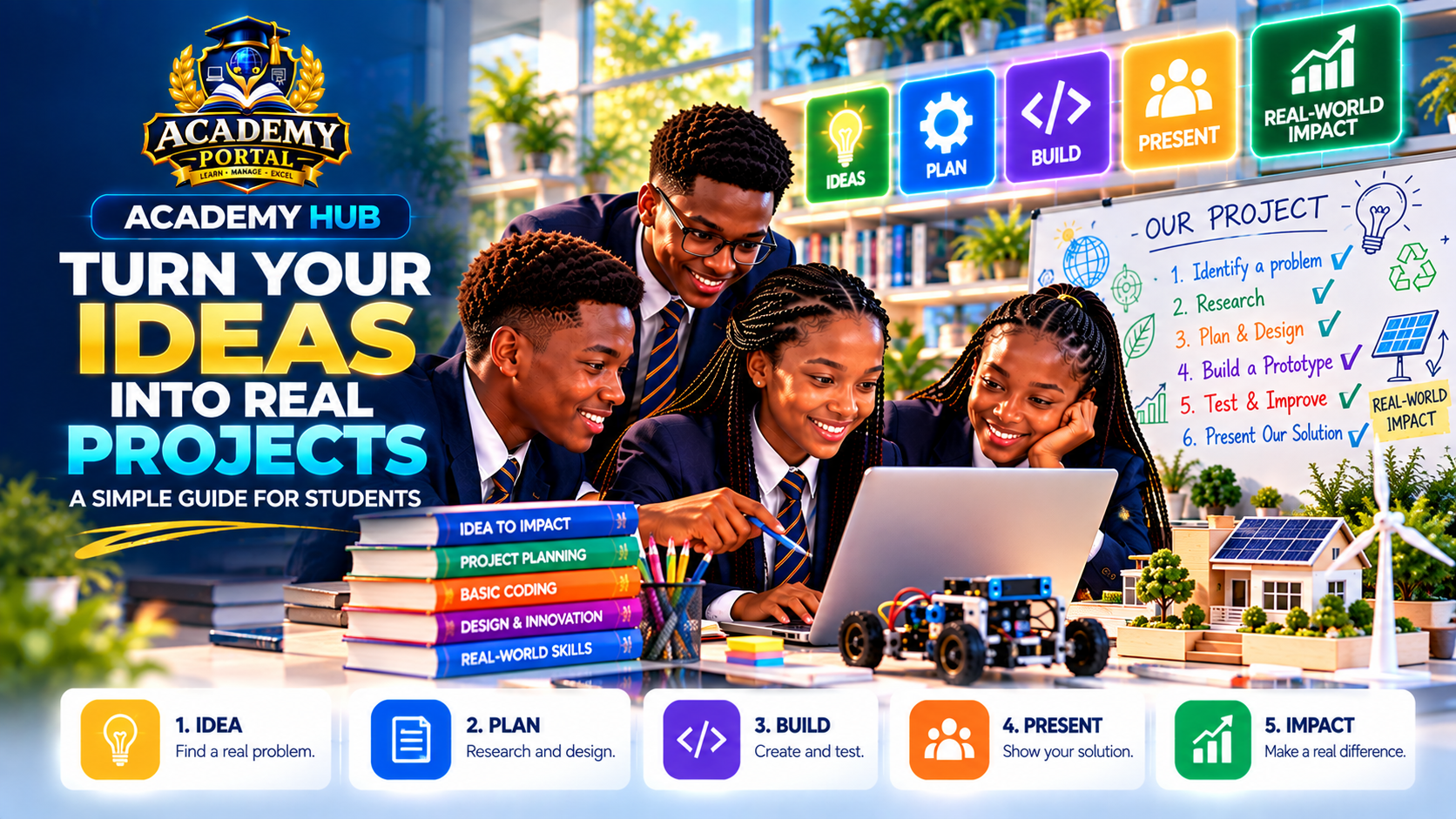
A project begins when you turn an idea into a problem you can investigate, a plan you can follow and something you can test.
1. Identify a real problem
Look around your school, home or community. Write the problem in one clear sentence before jumping to a favourite solution.
Instead of “I want to build an app,” begin with “Students need a clearer way to keep track of assignment deadlines.”
2. Investigate before building
Find out who experiences the problem and what already exists. Ask appropriate users questions, observe the current process and study similar solutions.
3. Define success
How will you know the project helped? Measures might include fewer forgotten tasks, faster completion, improved results, reduced waste or useful user feedback.
4. Plan the smallest useful version
A large idea becomes manageable when divided into smaller pieces. Ask: What is the smallest version that lets me test the main idea?
5. Build and document
Keep notes about what you tried, what worked, what failed, what changed and why.
6. Test with real feedback
Give appropriate users a task and observe what happens. Feedback is information for the next version, not an insult to your idea.
7. Improve
Compare feedback with your success criteria. Fix important problems first. This cycle—build, test, learn, improve—is iteration.
8. Present the story
Explain the problem, who it affects, what you learned, your solution, how you built it, what testing showed and what you would improve next.
Project challenge
Create a one-page project brief containing:
- problem statement;
- intended users;
- three research questions;
- proposed solution;
- smallest prototype;
- success measure;
- first three actions.
Discuss it with a teacher or suitable mentor before building.
Academy Hub takeaway: Real projects grow through a disciplined journey: identify, investigate, plan, build, test, improve, present and measure impact.
Keep building on what you've learned.
Discover more practical technology, science, digital skills and learning resources across Academy Hub.