
Understanding Moments of a Force Through the Academy Virtual Lab
Learn the principle of moments by exploring force, perpendicular distance and turning effect through an interactive virtual-lab example.
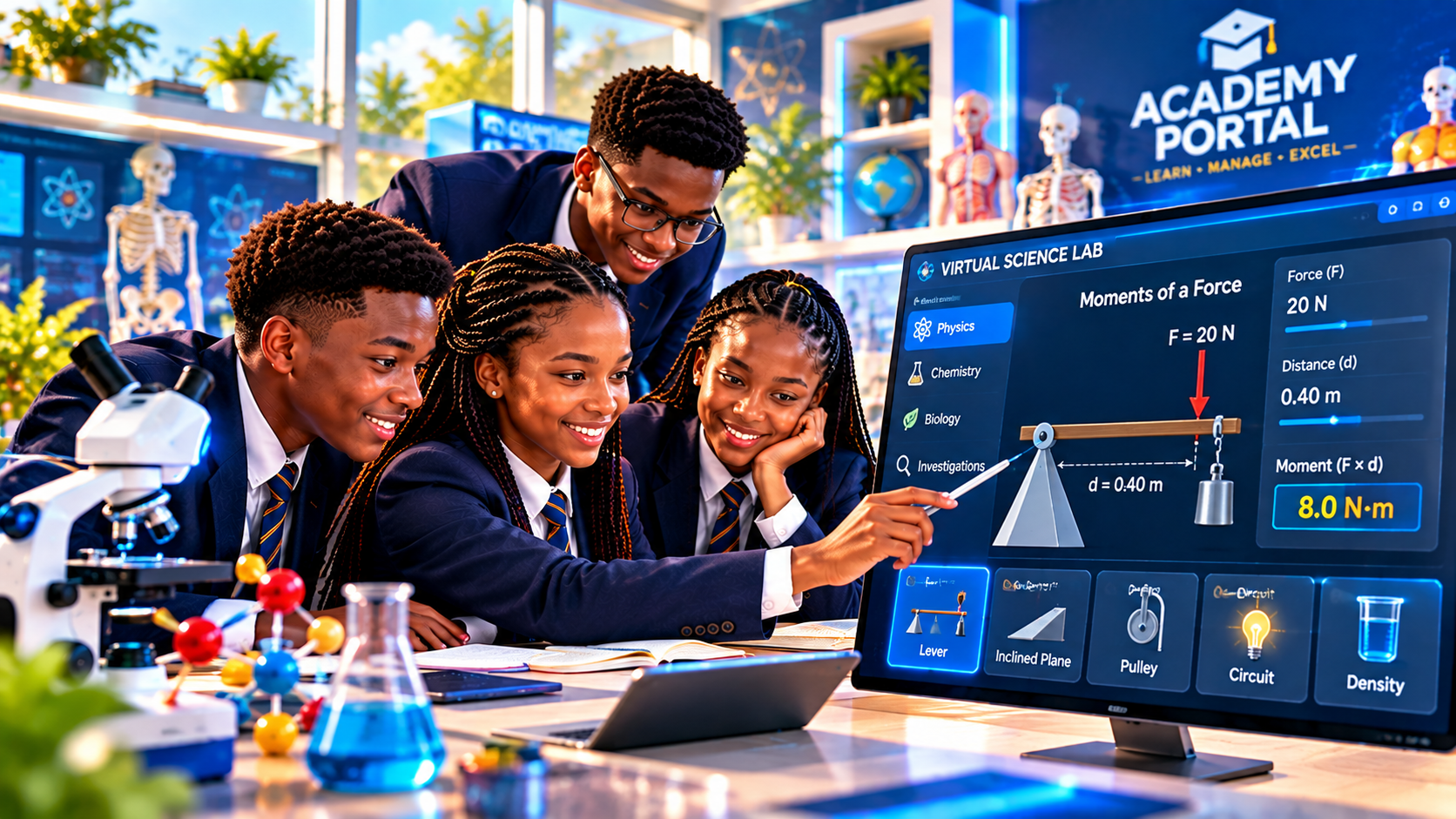
Why is it easier to open a door by pushing near the handle than close to the hinge? The answer involves the moment of a force—the turning effect produced by a force around a pivot.
Moment = Force × perpendicular distance from the pivot
M = F × d
With force in newtons (N) and distance in metres (m), moment is measured in newton metres (N·m).
Start with a baseline
For 20 N acting at 0.40 m:
M = 20 × 0.40 = 8.0 N·m
Double the force
Keep distance at 0.40 m and use 40 N:
M = 40 × 0.40 = 16.0 N·m
The force doubled while distance stayed constant, so the moment doubled.
Double the distance
Use 20 N at 0.80 m:
M = 20 × 0.80 = 16.0 N·m
Distance doubled while force stayed constant, so the moment doubled again.
Test a larger combination
For 50 N at 0.90 m:
M = 50 × 0.90 = 45.0 N·m
Predict the result before calculating. Prediction turns calculation into investigation.
Why perpendicular distance matters
The distance in the equation is the perpendicular distance from the pivot to the line of action of the force. Identifying this correctly is essential in more complex situations.
Everyday examples
Moments appear when opening a door, using a spanner, balancing a seesaw, operating a lever or turning a handle.
Investigate systematically
In the Academy Virtual Lab, keep one variable fixed while changing the other. Build a table for force, distance and moment.
Ask:
- What happens when force doubles?
- What happens when distance doubles?
- Can different force-distance combinations produce the same moment?
- Does your calculation match the simulation?
Challenge
Find three different combinations of force and distance that each produce 20 N·m.
Academy Hub takeaway: A moment depends on both force and perpendicular distance. Virtual experimentation turns M = F × d into a relationship you can see, test and explain.
Keep building on what you've learned.
Discover more practical technology, science, digital skills and learning resources across Academy Hub.